I came across a TED video of Sam Harris about a week ago, which then prompted me to get his book, The End of Faith, to see what his reasons are for not only not believing in religion, but saying that such an institution is actually destroying us. I usually don’t come across such strong opinions against religion, so I was definitely intrigued. I’ve gone from not really caring to thinking about believing to trying to believe and back. I settled somewhere between agnostic and atheist and haven’t really explored it since.
At work, I mentioned the premise of the book to two coworkers and one of them happened to find this YouTube playlist on Reddit that very night. He shared it with me and I spent the night listening to this discourse (don’t worry, it’s very much in English, the intro just happens to be in Spanish because it was held in Mexico – I was confused at first too!). It’s interesting to see how everything panned out – this is obviously a very hot issue, and one that people find very personal. Tempers inevitably flare when people with opposing views try to talk some sense into each other. I was almost more interested in their interactions and what they chose to focus on to support their opinions than the actual points themselves.
Admittedly, everyone brought up good points that are worthy of some pondering. I was also amused by the last guy, who was a bit of an outcast, not fitting in with either camp and actually the very type of person that both sides could probably agree to dislike. He seemed to best fit and agnostic point of view, dipping his toes onto either side. Neither here nor there, so he became the pariah, pointing out cons to both points of view. I could sympathize with him, since I don’t like the idea of outright blasting the other side (no matter which side you are on). I’ll just continue to read the book I have (and the follow-up, Letter to a Christian Nation) and see what I may learn in the process. I’m sure there will be a lot to consider.
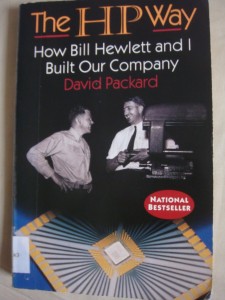 In reading it, I’m still not sure I’ve gotten much out of it and I’ve only got another 50 pages to go. There’s been a lot of random background stories and detailing of this and that technology that they or their acquaintances pioneered, but hardly much mention of the HP way other than some quick references to their rewarding pay scheme, dedication to quality and innovation, and decentralized structure. Perhaps it’s because what they were doing at the time was completely revolutionary, but now I find that these strategies are more commonplace and certainly nothing too exciting. I was hoping for a better collection of sage advice that I could soak up, but instead I find certain ideas reinforced, but not much else.